Equipment
Rooftop Unit Curbs
- You See
Stains in a ring below an HVAC unit.
- What It Means
Base flashing shrank or cracked at the corners, counterflashing came loose, or the curb-to-unit gasket dried out. The curb and the unit both get checked.

As an Erlanger commercial roof leak repair contractor, we follow each drip from the ceiling stain back to the curb, boot, seam, or drain letting water in.
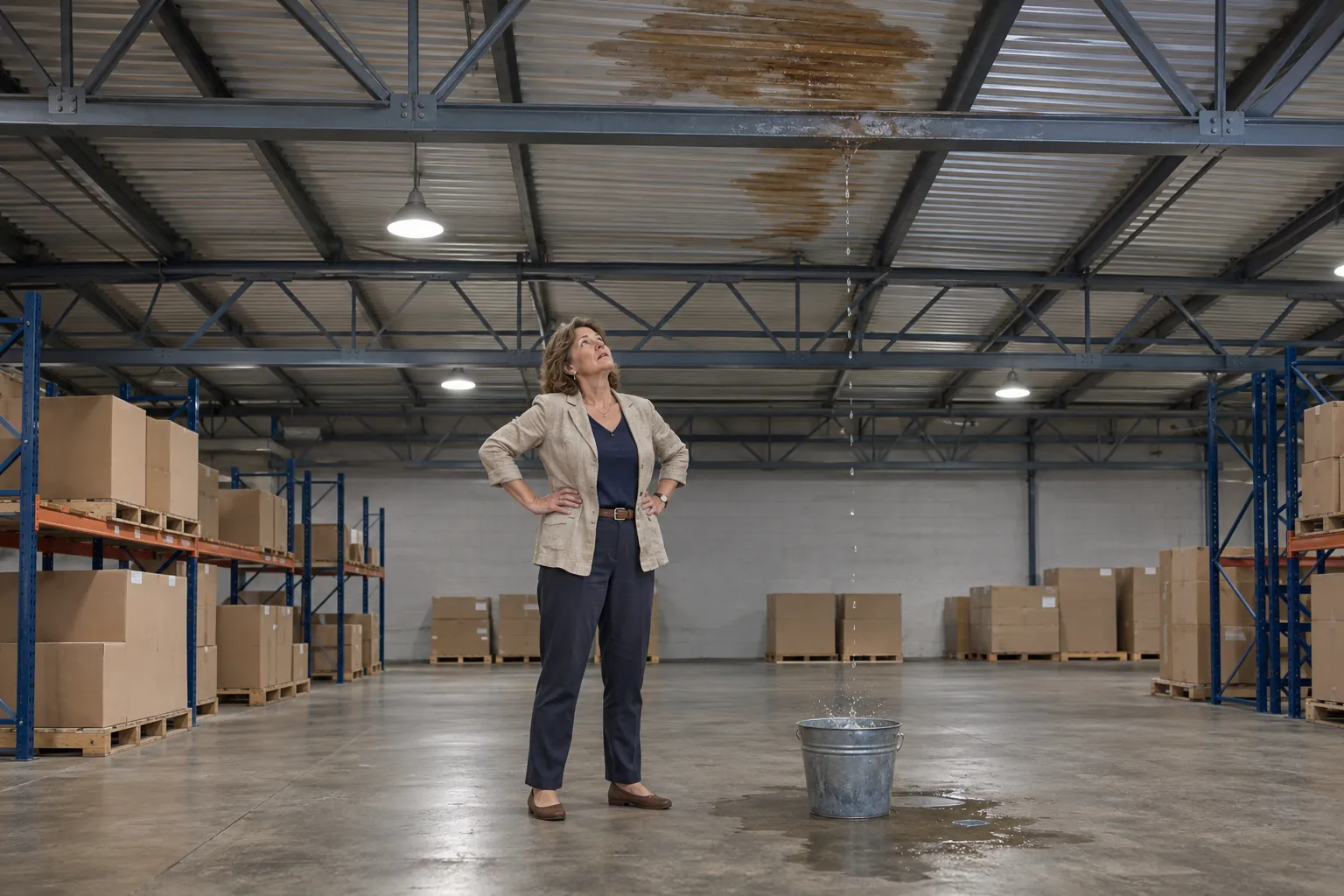
An Erlanger commercial roof leak repair contractor needs the source before patching, so the first column is often tracing.
| Roof Condition | Trace First | Repair Directly | Temporary Seal Now |
|---|---|---|---|
| Stain with no visible damage above it | Usually Fits | Rarely | Rarely |
| Cracked base flashing at a rooftop unit | Rarely | Usually Fits | Rarely |
| Active drip over stock or equipment | Sometimes | Rarely | Usually Fits |
| Leak only during wind-driven rain | Usually Fits | Rarely | Rarely |
| Shrunken filler in a pitch pan | Rarely | Usually Fits | Rarely |
Leaks that appear only in wind-driven rain often come from wall flashing, coping, or rooftop unit panels, so note the weather each time.
The open field of a roof rarely fails first. These spots do.
Stains in a ring below an HVAC unit.
Base flashing shrank or cracked at the corners, counterflashing came loose, or the curb-to-unit gasket dried out. The curb and the unit both get checked.
Drips near gas lines, conduit, or vent pipes.
Pitch pan filler shrinks away from pipes over time, and rubber boots crack. Refilling, capping, or swapping the pan for a boot or curb ends the repeat leak.
Leaks that show only when rain blows sideways.
Open coping joints or loose wall flashing let wind push water behind the membrane. Resealing joints and refastening flashing closes the gap.
A new leak right after HVAC or electrical service.
Each unit, fan, and pipe stand adds a seam in the waterproofing. Many leaks trace back to cuts or missing seals from other work on the roof.
Once the entry point is confirmed, the repair fits that detail.
New base flashing wraps up the curb, counterflashing gets refastened and resealed, and a cricket goes on the uphill side so water stops pooling against it.
Pitch pans get cleaned out, refilled with pourable sealer mounded to shed water, and capped. Round pipes get new prefabricated boots matched to the membrane.
Water goes on one roof area at a time while someone watches inside. It is the slow way to find a hidden source, and the sure one.
Peel-and-stick patches or tarps stop active water fast when the roof is wet or cold, followed by a permanent repair planned for the first dry stretch.
Ceiling tiles and buckets treat the symptom. These are the gains from fixing the detail above them.
Fixing the curb or boot that lets water in ends the cycle of patching the ceiling, replacing tiles, and calling again after the next storm.
CurbsWater traveling along steel deck flutes rusts the deck over time. Stopping it at the entry point keeps that damage from spreading bay by bay.
DeckSwapping an old pitch pan for a curb or boot during the repair removes a roof detail that needs refilling every few years.
PenetrationsPhotos and notes on each source build a map of the roof, so the next leak gets traced in less time.
RecordsProtect people and property first, then call. These notes save tracing time once the crew is on the roof.
Each step narrows the search from the whole roof to one detail.
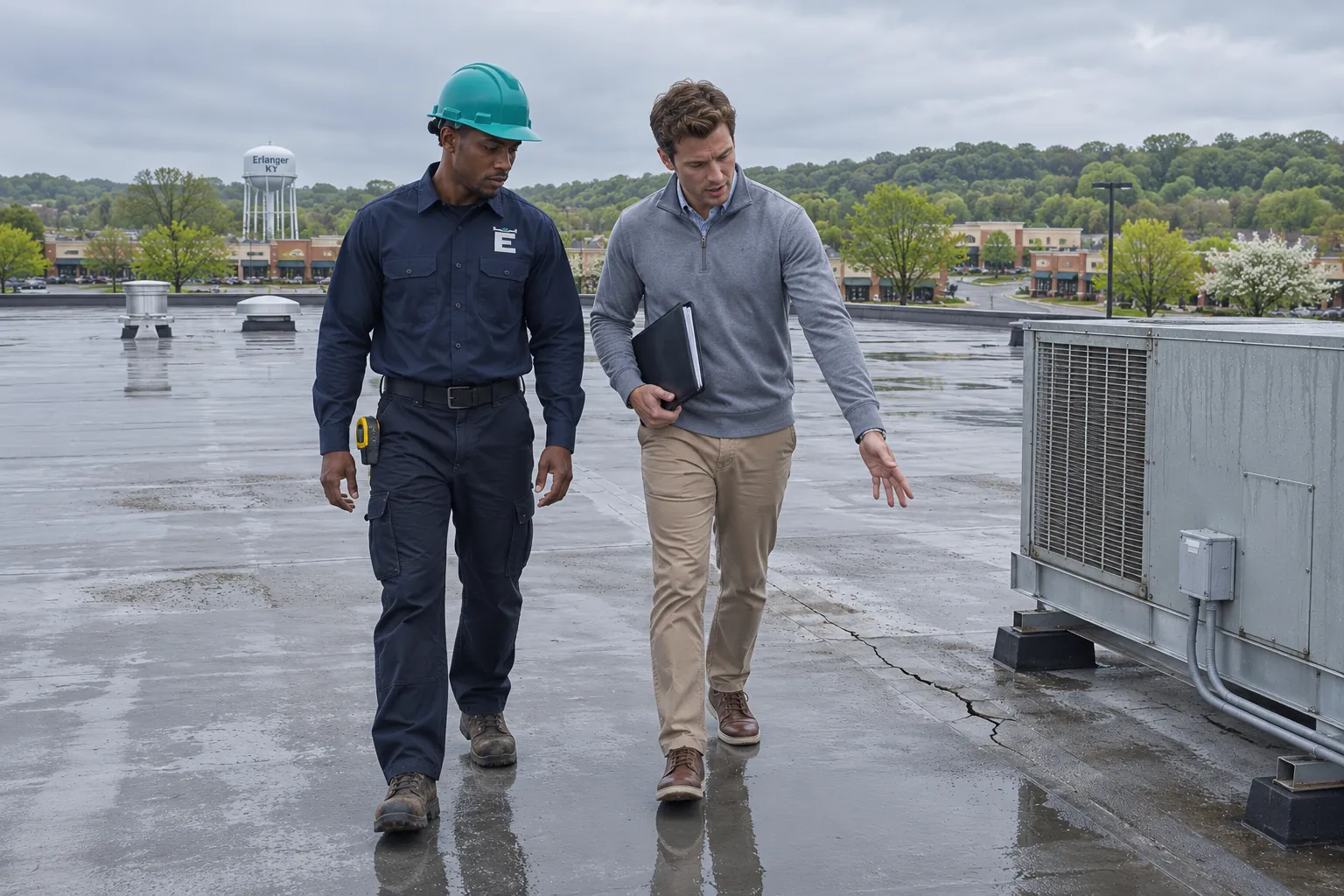
The interior deck gets checked first for water stains and rust trails, then the roof directly above and uphill of each drip, including seams, curbs, drains, and pipe boots.
Drip locations go on a floor plan so the roof crew can line them up with the curbs, drains, and penetrations above.
When the source hides, water goes on one section at a time while someone watches inside. Infrared or meter scans map any wet insulation found along the way.
Curb flashing, boots, pitch pans, or seams get rebuilt with matching materials, and any temporary patch comes off first.
The repaired curb, boot, or seam gets checked again, and the report shows the cause, the fix, and nearby spots worth watching.
A traced leak often points to a bigger repair on one roof system.
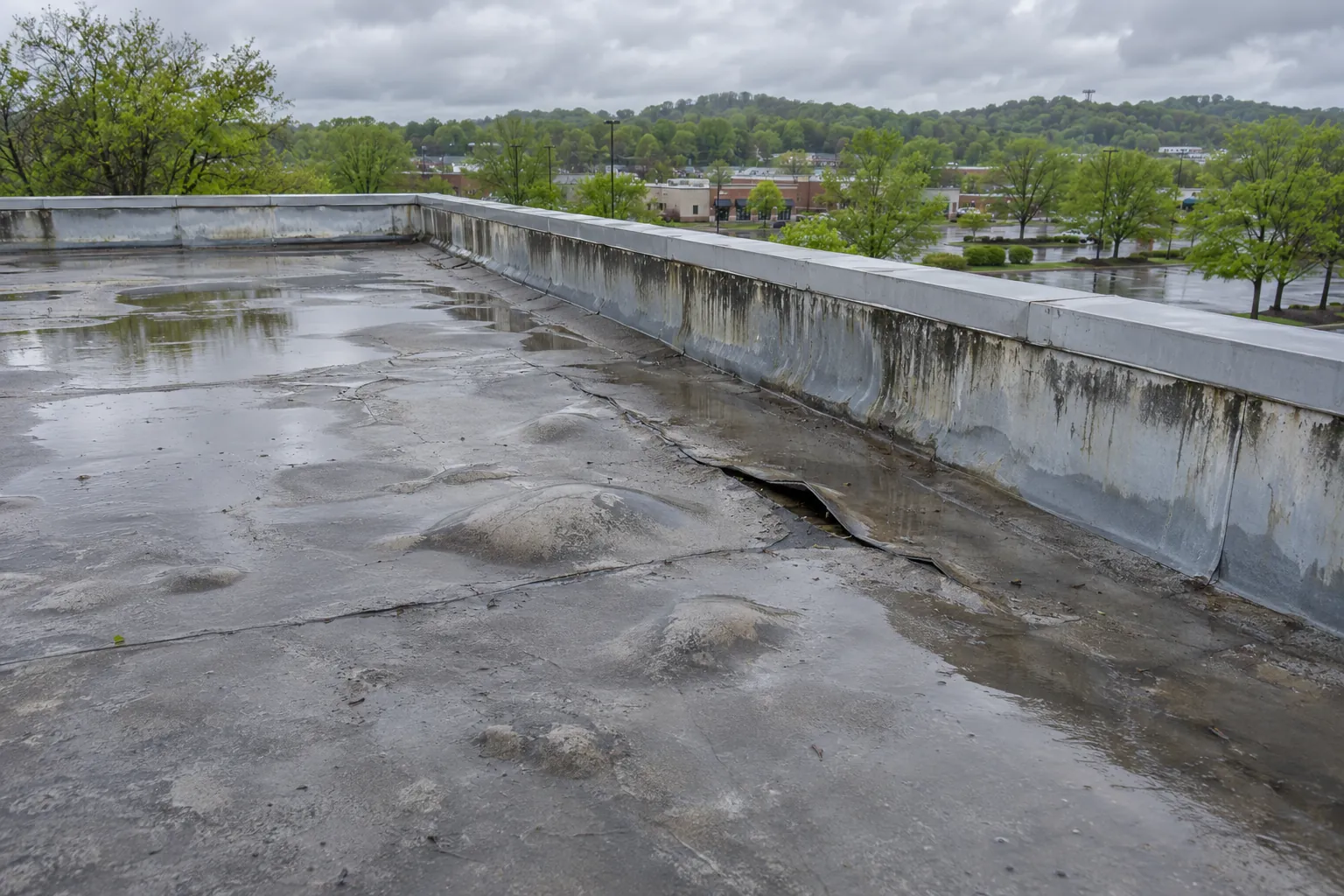
When tracing finds wet insulation spreading from a seam, flat roof repair cuts out and replaces the soaked boards.
Flat roof repair in Erlanger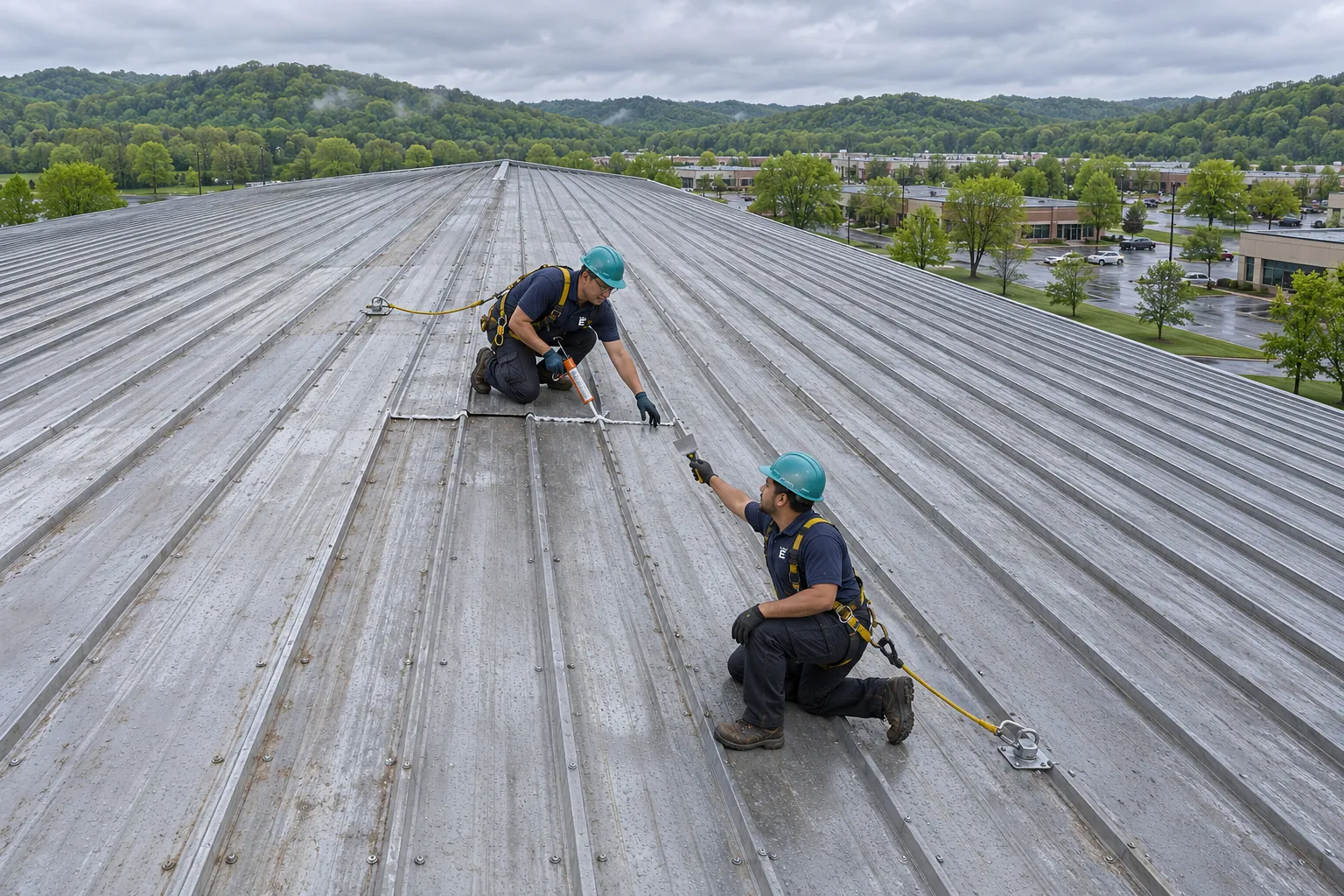
Leaks traced to screw rows and end laps lead into a full fastener and lap repair across the panel run.
Metal roof repair in Erlanger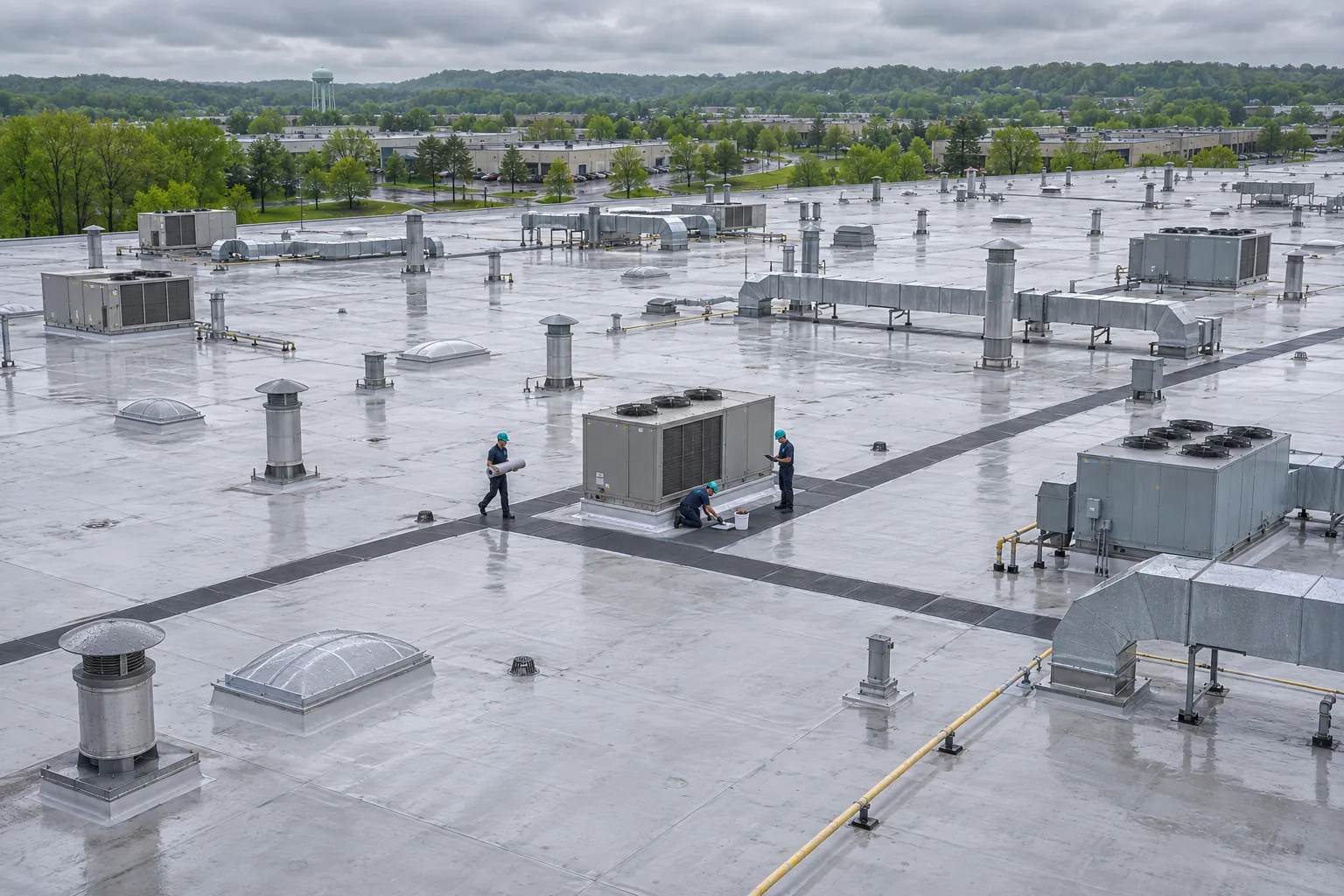
Plant leaks from grease-damaged membrane around exhaust fans need resistant membrane and containment.
Industrial roof repairAnswers on tracing, curbs, penetrations, and what to do inside.
Tracing starts at the interior stain, then moves to the roof directly above and uphill to check every seam, flashing, and penetration in the path. Controlled water testing and moisture scans narrow it down when the source hides.
Flashing at curbs, walls, and penetrations leads on membrane roofs, while fasteners and laps lead on metal roofs. TPO fails at curb corners and welds, EPDM at seam edges and T-joints, and built-up roofs at pitch pans and wall flashing.
Cracked or loose base flashing gets replaced, counterflashing gets refastened and resealed, and gaps where the unit sits on the curb get closed. The curb-to-unit gasket and loose access panels are HVAC work, so that contractor joins the repair.
Pitch pans get cleaned out, refilled with pourable sealer mounded to shed water, and capped. Round pipes get new prefabricated boots, conduit clusters move into a sealed box or curb, and gas lines go on pipe stands so they stop rubbing the membrane.
Move inventory and electronics away from the drip, set out containers and absorbent mats, and shut off power to anything getting wet. Photograph the stain and note the time, weather, and wind direction. Roof checks wait until conditions are safe.
Yes, before they fall. Wet tiles get heavy fast, and pulling them also shows where water is running along the deck or a beam, which helps the crew line the drip up with the roof above.
Describe where the drip lands and when it started. We trace it back to the detail letting water in.