
Erlanger Commercial Roof Repair Questions
Answers on Seams, Curbs, Drains, Fasteners, Permits, and Costs
These Erlanger commercial roof repair questions cover leaks, flat and metal roof repairs, curbs, drains, storm checks, Kenton County permits, and taxes.
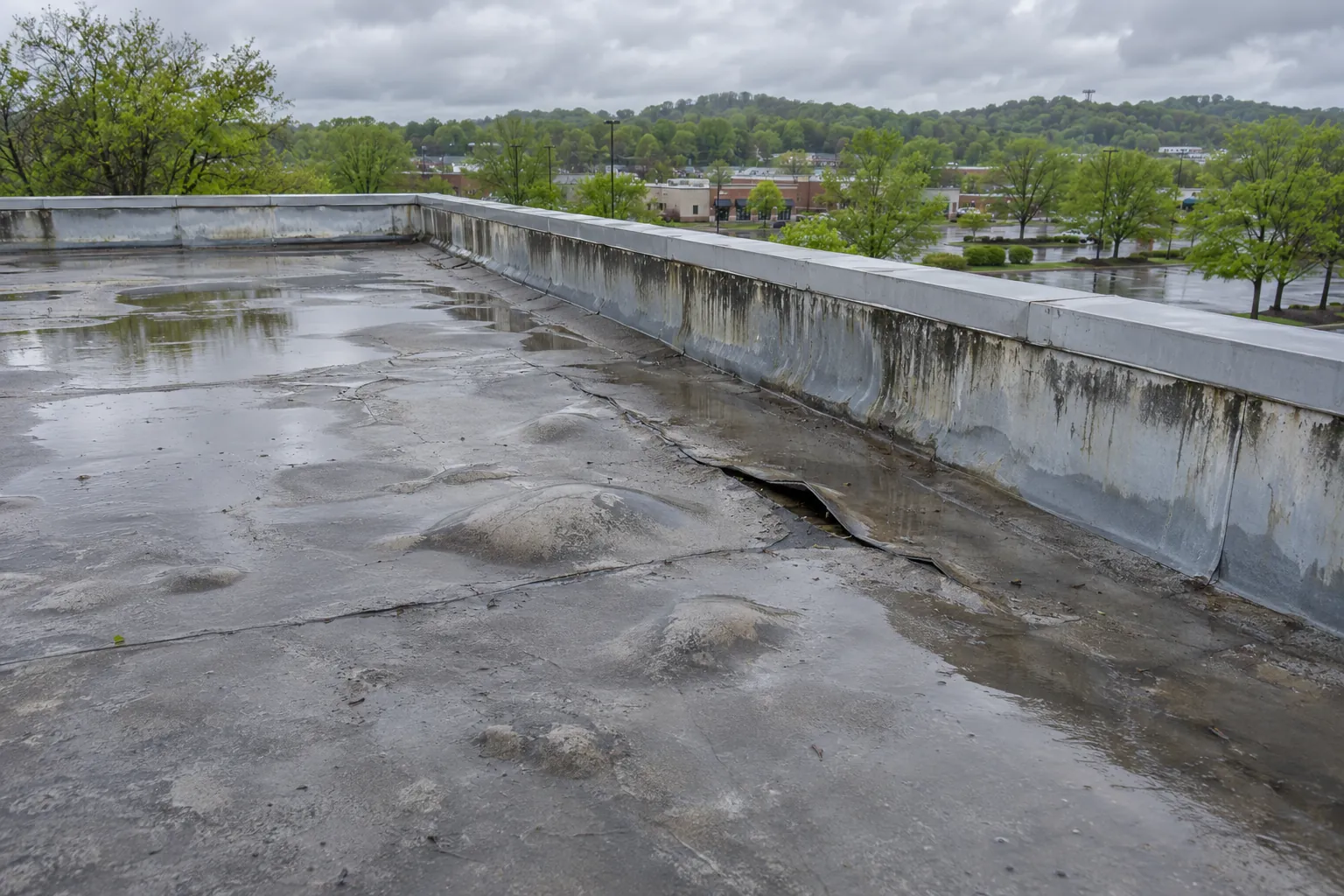
Erlanger Commercial Roof Repair Questions by Topic
Every one of these Erlanger commercial roof repair questions comes from building owners and managers, grouped by topic with each answer open below.
Commercial roof repair is the work of tracing leaks and fixing damaged membranes, flashing, drains and metal panels on business, industrial and agricultural buildings. Erlanger Commercial Roof Repair fixes flat roofs, metal roofs and industrial roofs in Erlanger and surrounding towns across Kenton County, Kentucky, starting with where the water gets in.
Roof Repair Basics
What kinds of commercial roof damage can be repaired?
Most leaks and damage that stay limited to a few areas of a commercial roof can be repaired with patches, new flashing or replaced parts. Repair work covers both membrane roofs and metal roofs.
Common repairable problems:
- Open seams and laps on TPO, EPDM or modified bitumen.
- Punctures from dropped tools, hail or foot traffic near rooftop units.
- Cracked or loose flashing at curbs, walls and pipes.
- Clogged or broken drains, scuppers and gutters.
- Backed-out fasteners and worn washers on metal panels.
- Rust spots and holes in individual panels or end laps.
Damage spread across most of the roof, especially wet insulation under large areas, moves the conversation toward restoration or replacement. Each repair starts by checking how far the problem reaches.
How do you decide between repairing, restoring or replacing a commercial roof?
The choice comes down to how much of the roof is damaged and whether the insulation underneath is still dry. Localized trouble gets repaired, aging but dry roofs can be restored, and wet or worn-out assemblies get replaced.
| Path | Roof condition | Work involved |
|---|---|---|
| Repair | A few leaks, seams or flashing failures | Patch, reseal, replace parts |
| Restore | Surface aging across a dry roof | Repairs plus a coating system over the whole roof |
| Replace | Widespread wet insulation, deck damage or many failed seams | Tear-off or recover with a new roof |
Moisture readings decide many of these calls. A roof that looks rough but tests dry often has years of repair or restoration ahead of it, while a neat-looking roof hiding soaked insulation will keep leaking.
Why does water drip inside far from where it gets into the roof?
Water enters at one spot and then runs along the deck, insulation joints or purlins before it finds a way through the ceiling. On low-slope roofs with steel decks, it can travel along the flutes for many feet.
Paths water follows inside a roof:
| Roof type | Where water travels |
|---|---|
| Membrane over steel deck | Along deck flutes to a fastener hole or seam |
| Membrane over concrete | Across the slab to a crack or edge |
| Metal panel roof | Down purlins and along the underside of panels |
| Built-up roof | Between plies before dripping at a joint |
That's why a drip over a warehouse aisle can come from a pipe boot or curb forty feet upslope. Leak tracing follows the path back by checking every penetration and seam above and uphill of the stain.
Which roof repairs count as temporary, and which count as permanent?
A temporary repair stops water quickly with materials that last until conditions allow a proper fix, while a permanent repair uses matching materials installed to manufacturer methods. Both have a place on commercial roofs.
| Feature | Temporary repair | Permanent repair |
|---|---|---|
| Purpose | Stop active water fast | Fix the cause for the long run |
| Materials | Roof cement, tarps, peel-and-stick patches | Matching membrane, welded or taped patches, new flashing |
| Weather | Done in wet or cold conditions | Needs dry surfaces and suitable temperatures |
| Follow-up | Must be replaced later | Inspected on normal checks |
Roof cement smeared over a TPO seam, for example, holds briefly but contaminates the membrane and makes the later weld harder. Planning the permanent fix right after a temporary patch keeps small problems from growing.
Flat Roof Repair Questions
Which flat roof problems can be repaired without replacing the roof?
Open seams, small punctures, loose flashing, blisters and clogged drains on a flat roof are all repairable when the insulation around them is dry. Flat roofs fail at details more than across the field, so targeted repairs go a long way.
Repairable flat roof issues by location:
| Location | Typical problem | Repair |
|---|---|---|
| Field seams | Open or lifted laps | Reweld TPO, retape EPDM |
| Membrane field | Punctures and cuts | Matching membrane patch |
| Curbs and walls | Shrunken or torn base flashing | New flashing and termination bar |
| Drains | Loose clamping ring, debris | Reset ring, clean strainer |
| Parapet cap | Open coping joints | Reseal or replace coping |
Wet insulation found during a repair gets cut out and replaced in that area before patching. Leaving soaked boards under a patch traps water and spreads the damage.
How are blisters on a flat commercial roof repaired?
On built-up or modified bitumen roofs, blisters get cut open, dried out and patched with matching material. They form when moisture or air trapped between plies expands in summer heat and lifts the surface.
Repair steps for a blister:
- Cut an X or a square through the raised area.
- Fold back the flaps and let the inside dry.
- Check the insulation underneath for moisture.
- Seal the flaps back down with compatible cement or torch heat.
- Cover the cut with a patch extending past the edges.
Small, stable blisters that are unbroken are sometimes left and watched. Cracked blisters, or ones that grow each summer, need repair before water reaches the insulation.
What can be done about ponding water on a flat roof?
Ponding is fixed by clearing drains, adding tapered crickets to steer water, or raising low areas where the deck has sagged. Water that sits more than a couple of days after rain speeds up wear on seams and membrane surfaces.
Causes and fixes:
- Clogged drain strainers, cleared and fitted with new domes.
- Drains set too high after earlier recovers, lowered or replaced with retrofit drains.
- Missing crickets behind curbs, added with tapered insulation.
- Sagging deck between joists, checked by an engineer before shimming or reinforcement.
- Debris dams from leaves and loose gravel, removed during routine checks.
Ponding over a deflected deck is a structural question first. A roofer can patch the membrane, but the deck support decides whether water keeps collecting there.
How are TPO, EPDM and modified bitumen roofs patched?
Each flat roof membrane gets patched with its own material and bonding method, since mixing products causes poor adhesion. Identifying the membrane is the first step of any patch.
| Membrane | Patch method | Prep before patching |
|---|---|---|
| TPO | Hot-air welded TPO patch | Clean with membrane cleaner; weathered TPO needs extra prep to accept a weld |
| EPDM | Primer with peel-and-stick or seam tape patch | Scrub with primer to remove chalky residue |
| Modified bitumen | Torch-applied or cold-adhesive cap sheet patch | Remove loose granules and debris |
| Built-up roof | Plies of felt and asphalt or mastic and fabric | Clear gravel from the patch area |
Patches extend several inches past the damage on all sides, with rounded corners so edges lie flat. Probing welded patches after cooling confirms they held.
How is wet insulation found and replaced under a flat roof?
Wet insulation under a flat roof is located with moisture meters, infrared scans or core cuts and then cut out and replaced with dry boards. Soft spots underfoot are often the first sign.
Ways to find moisture:
- Handheld moisture meters swept across suspect areas.
- Infrared scans at dusk, when wet insulation holds heat longer than dry.
- Core cuts that pull a sample down to the deck for a direct look.
Repair involves removing the membrane over the wet area, pulling out soaked boards, and installing new insulation and cover board to match the surrounding height. A new membrane section is then welded or taped in. When wet areas cover a large share of the roof, piecing it back together costs more than it saves.
Commercial Metal Roof Repair Questions
What usually causes leaks on a commercial metal roof?
Leaks on commercial metal roofs most often come from failed fastener washers, open end laps, loose trim and worn flashing around penetrations. The panels themselves usually outlast the parts that seal them.
Where metal roof leaks start:
| Spot | Cause |
|---|---|
| Exposed fasteners | Dried washers, screws backed out by panel movement |
| End laps | Sealant failure where panels overlap downslope |
| Ridge and eave | Missing closures, loose trim |
| Pipe and vent boots | Cracked rubber, loose collars |
| Curbs | Missing crickets that let water pond uphill |
| Gutters | Rusted seams and loose hangers |
Daily heating and cooling moves the panels, which works screws loose over the years. Long roof runs on warehouses and shops see the most movement and the most fastener leaks.
How is fastener back-out repaired on a metal roof?
Backed-out fasteners are repaired by removing them and driving new screws with fresh washers, often one size larger so they grip in stretched holes. A loose screw lets water run down the shank into the building.
Fastener repair checklist:
- Pull each loose or rusted screw.
- Upsize to a larger diameter screw where the hole is wallowed out.
- Drive to the right torque so the washer seals without crushing.
- Seal stripped holes that cannot take a new screw with a metal patch.
- Check neighboring fasteners in the same row, since they age together.
Fastener caps or sealant over the heads add protection on older roofs. On large exposed-fastener roofs, a full fastener repair across the roof is often the most practical way to stop leaks for good.
Should a rust-damaged metal panel be patched or replaced?
Rusted metal panels can be patched when the rust is limited to small holes or spots, while panels with widespread rust-through need replacing. The repair depends on how much solid metal remains.
| Rust level | Repair |
|---|---|
| Surface rust, no holes | Wire brush, prime, and seal |
| Small pinholes | Clean, prime, and cover with a metal or fabric patch |
| Rust-through at eave or end lap | Cut out section and install a new panel piece |
| Rust across most of the panel | Replace the full panel |
Matching profile and color matters for replacement panels. R-panel and PBR panels come in many profiles, so a sample of the existing panel helps get the right match. Rust that comes back at the same spots points to trapped water at laps or condensation from inside the building.
How are end laps and ridge caps repaired on metal roofs?
End laps and ridge caps are repaired by cleaning out old sealant, replacing closures and fasteners, and resealing with butyl tape or a compatible sealant. These are among the most common leak points on metal buildings.
End lap repair steps:
- Remove loose sealant and debris from the lap.
- Replace rusted stitch screws along the lap.
- Apply new butyl tape or sealant as specified for the panel.
- Reinforce the lap surface with a fabric-backed sealant on older roofs.
Ridge caps often leak where foam closures have crumbled or blown out, letting wind-driven rain under the cap. New closures, cap fasteners and sealant at the cap laps fix most ridge leaks.
How are gutters and box gutters on metal buildings repaired?
Leaking gutters on metal buildings are repaired by resealing seams, replacing rusted sections and refastening loose hangers. Built-in box gutters set inside the roof line need special care, since a leak there drips straight into the building.
Gutter repairs by type:
| Gutter type | Common problem | Repair |
|---|---|---|
| Hanging eave gutter | Seam leaks, sagging | Reseal joints, add hangers |
| Box gutter | Rusted bottom, failed seams | Line with membrane or replace section |
| Downspout | Clogs, crushed bottoms | Clear and replace damaged pieces |
| Gutter outlet | Loose connection | Reseal or replace outlet tube |
Overflowing gutters often back water under the eave trim and into the wall. Cleaning and checking gutters after leaf drop prevents many of these leaks.
Commercial Roof Leak Repair Questions
How is a commercial roof leak traced to its source?
Leak tracing starts at the interior stain, then moves to the roof directly above and uphill to check every seam, flashing and penetration in the path. Water testing and moisture scans narrow it down when the source hides.
Tracing methods:
- Interior inspection of the deck to follow water stains and rust trails.
- Visual check of seams, curbs, drains and pipe boots above the leak.
- Controlled water testing, flooding one area at a time while someone watches inside.
- Infrared or moisture meter scans to map wet insulation.
Leaks that appear only during wind-driven rain often come from wall flashing, coping or rooftop unit panels. Noting weather conditions when a leak shows up helps pinpoint the cause.
Which parts of a commercial roof leak most often?
Flashing at curbs, walls and penetrations leaks most often on membrane roofs, while fasteners and laps lead on metal roofs. The open field of a roof rarely fails first.
| Roof type | Most common leak points |
|---|---|
| TPO | Curb flashing corners, failed welds, pipe boots |
| EPDM | Seam edges, shrinkage at walls, T-joints |
| Modified bitumen | Blisters, cracked flashing, open laps |
| Built-up roof | Pitch pans, flashing at walls, cracks in ponding areas |
| Metal | Fasteners, end laps, ridge closures, skylight edges |
Rooftop equipment adds more risk. Each RTU, exhaust fan and pipe stand creates another seam in the waterproofing, and many leaks trace back to work done by other trades on the roof.
How are leaks around rooftop units and curbs repaired?
Curb leaks are repaired by replacing cracked or loose base flashing, resealing counterflashing, and fixing gaps where the unit sits on the curb. Water also enters through the unit itself, so the curb and the RTU both get checked.
Places to inspect at a rooftop unit:
| Spot | Cause | Fix |
|---|---|---|
| Base flashing | Shrinkage, cracks at corners | New flashing wrapped up the curb |
| Counterflashing | Loose or missing metal cap | Refasten and reseal |
| Curb-to-unit gasket | Dried or missing seal | Replace gasket with HVAC contractor |
| Unit panels | Loose access doors | HVAC service |
| Condensate line | Draining onto the membrane | Route to a drain |
Curbs with no cricket on the uphill side hold water against the flashing. Adding a cricket during repair keeps water moving around the curb.
How are pitch pans and pipe penetrations repaired?
Pitch pans are repaired by cleaning out shrunken filler, refilling with pourable sealer, and capping the pan so water sheds off, while pipe penetrations get new boots or flashing sleeves. Both are frequent leak points on older flat roofs.
Repair options by penetration:
- Pitch pans, cleaned and refilled with pourable sealer mounded to shed water.
- Round pipes, fitted with new prefabricated boots matched to the membrane.
- Clusters of conduit, moved into a single curb or flashed with a sealed box.
- Gas lines, supported on pipe stands so they stop rubbing the membrane.
Pitch pans need regular checks because the filler shrinks and pulls away from pipes over time. Replacing a pitch pan with a curb or boot during a repair removes a repeat problem.
What should a building manager do inside when the roof starts leaking?
Inside, a building manager should protect people and property first by moving equipment and stock away from the drip, catching water, and marking the spot. Those notes help the repair crew trace the leak quickly.
Steps to take indoors:
- Move inventory, electronics and furniture away from the leak.
- Set containers to catch water and lay down absorbent mats.
- Shut off power to any fixture or equipment getting wet.
- Photograph the stain, drip location and ceiling damage.
- Note the time, weather and wind direction when the leak started.
Going onto a roof during a storm puts people at risk, so roof checks wait until conditions are safe. Saturated ceiling tiles should be removed before they fall.
Industrial Roof Repair Questions
What repair problems are common on industrial roofs?
Industrial roofs commonly suffer from grease and chemical damage, punctures from heavy maintenance traffic, and leaks around large equipment and process vents. These buildings put more stress on the roof than offices or retail.
Common industrial roof repairs:
- Membrane softened or swollen by oil around exhaust fans.
- Torn flashing at equipment rails, stacks and pipe stands.
- Punctures from dropped tools and parts near service areas.
- Vibration damage around large fans and compressors.
- Clogged drains from dust and process residue.
Repairs on these roofs focus on stopping the source of damage as well as fixing the membrane. A patch over grease-damaged EPDM fails quickly unless the grease stops reaching it.
How is membrane damaged by grease or chemicals repaired?
Membrane damaged by grease or chemicals is repaired by cutting out the softened area and replacing it with a resistant membrane, then adding containment so the problem stops. Oils break down EPDM fastest, while PVC resists grease better.
Repair process for contaminated areas:
| Step | Action |
|---|---|
| 1 | Identify the source, such as kitchen exhaust or process vents |
| 2 | Clean residue from surrounding membrane |
| 3 | Cut out swollen or soft membrane |
| 4 | Install a resistant membrane section and flash it in |
| 5 | Add grease containment or traps at the fan |
Regular cleaning around exhaust fans reduces repeat damage. Walkway pads near these areas also protect the repaired section from foot traffic during fan servicing.
Can roof repairs happen while an industrial plant keeps running?
Roof repairs on an industrial plant usually proceed during normal operations, with careful scheduling around hot work, crane lifts and sensitive areas. Most repairs happen from the roof surface and do not require interior shutdowns.
Coordination items for plant repairs:
- Hot-work permits for torch-applied or heat-welded repairs.
- Air intake shutdowns when welding fumes or adhesives are used near units.
- Lockout of equipment if repair work touches rooftop machinery.
- Interior protection under repair areas over production lines.
- Shift scheduling so noisy work avoids quiet operations.
Plant safety rules apply to the roof crew too, so orientation and site-specific procedures come first.
How are roof drains on large industrial roofs repaired?
Industrial roof drains get repaired by replacing broken clamping rings and strainers, resealing the membrane at the drain bowl, and clearing the pipes. Large roofs depend on a few drains moving water from huge areas, so one failed drain causes wide ponding.
Drain repair options:
| Problem | Repair |
|---|---|
| Loose or broken clamping ring | Replace ring and bolts |
| Missing strainer dome | Install a new dome |
| Membrane leaking at the bowl | Reflash with new membrane |
| Damaged drain body | Insert a retrofit drain |
| Clogged leader pipe | Clear from roof or interior cleanout |
Overflow drains or scuppers on parapet roofs give water a second exit when primary drains clog. Keeping them clear matters as much as fixing the main drains.
How are expansion joints and damaged decking repaired on industrial roofs?
Expansion joints are repaired by replacing torn joint covers and flashing, while damaged decking gets cut out and replaced or reinforced before new insulation and membrane go on. Both repairs keep large industrial roofs moving and supported properly.
Expansion joint and deck repairs:
- Joint covers replaced with new bellows or flexible membrane material.
- Flashing at each joint tied into the surrounding membrane on both sides.
- Rusted steel deck plates cut out and replaced with new panels.
- Weakened wood or concrete decks evaluated by an engineer.
Deck damage often starts from long-term leaks, so the repair includes finding and stopping the original water entry. Deck repairs typically need a building permit, depending on scope.
Commercial Roof Repair Questions on Weather, Permits and Codes in Erlanger
What should be checked on a commercial roof after a storm in Erlanger?
After a strong storm, the roof edges, coping, membrane field, rooftop units and drains are the first places to check for wind and hail damage. Wind starts lifting a roof at its corners and perimeter, so loose edge metal is often the earliest warning.
Storm check by area:
| Area | Signs of damage |
|---|---|
| Edge metal and coping | Lifted, bent or missing sections |
| Membrane field | Punctures from branches, bruises from hail |
| Rooftop units | Shifted units, loose access panels, torn curb flashing |
| Drains and scuppers | Leaves and limbs blocking flow |
| Skylights and metal panels | Cracked lenses, dented or lifted panels |
Photos taken soon after the storm, with dates, help with any insurance claim. Short-term patches hold water out until the roof dries enough for permanent work.
How do Kenton County freeze and thaw cycles open up roof leaks?
Freeze and thaw cycles open leaks by letting water seep into seams, cracks and drains, freeze and expand, then melt and run further in. National Weather Service normals for January in the Cincinnati area put the average low at about 23°F and the average high around 40°F, so Erlanger roofs cross the freezing mark again and again.
Winter damage tends to show up in four places:
- Gutters and eaves, where ice dams push meltwater under trim.
- Drain bowls, where frozen strainers stop flow and water rises against flashing.
- Cracks in aged built-up and modified bitumen roofs, which widen each cycle.
- Seams on old EPDM, which pull apart as the rubber shrinks in cold.
Clearing drains and gutters each fall cuts down on ice buildup. Repairs made on cold days rely on products rated for low application temperatures.
Does a commercial roof repair need a permit in Kenton County?
Permit needs for a roof repair in Kenton County follow the scope of the work, and Planning and Development Services of Kenton County (PDS) decides what applies. Kentucky enforces the 2018 Kentucky Building Code, built on the 2015 International Building Code, for commercial buildings.
Repair work that often brings PDS into the picture:
- Deck replacement or structural reinforcement under the roof.
- Large sections of membrane and insulation replaced at once.
- Rooftop units disconnected, lifted or swapped.
- New drains, scuppers or changes to how the roof drains.
Patching a seam or resealing a pipe boot is a different scale of job from rebuilding a section of deck. Describing the full scope to PDS before work starts settles the question.
Where do Elsmere, Edgewood and other nearby towns get roof repair permits?
One agency, Planning and Development Services of Kenton County (PDS), issues building permits across Erlanger and the nearby Kenton County cities, based on the state's list of county contacts. HVAC inspections are split between city and state inspectors.
| Town | Permit office | HVAC inspector listed |
|---|---|---|
| Erlanger | PDS | City of Erlanger |
| Elsmere | PDS | Ask PDS |
| Edgewood | PDS | Ask PDS |
| Crestview Hills | PDS | Ask PDS |
| Lakeside Park | PDS | Ask PDS |
| Crescent Springs | PDS | Ask PDS |
| Fort Mitchell | PDS | State inspector |
| Villa Hills | PDS | Ask PDS |
Curb leak repairs that lift a rooftop unit bring the HVAC side into play. Knowing which inspector covers the town keeps the unit from waiting off its curb.
Erlanger Questions About Commercial Roof Repair Cost, Value and Taxes
Why do two commercial roof repairs cost such different amounts?
The size and type of damage, the roof system, and what turns up under the membrane set the cost of a commercial roof repair. A small seam repair and a section of wet insulation replacement sit far apart in labor.
Cost factors to expect:
- Number and size of damaged areas.
- Membrane or panel type, and how easily matching material is found.
- Wet insulation or rusted deck uncovered during the repair.
- Height, roof access and whether a lift is needed.
- Rooftop unit coordination with an HVAC contractor.
- Weather windows, since some products need dry, mild conditions.
Leak tracing time also counts. A leak with a clear source takes far less time than one that has to be water tested section by section.
When does repairing a roof stop being worth the money?
Repairs stop being worth the money when leaks keep appearing in new spots, wet insulation spreads across large areas, or yearly repair spending approaches the cost of restoring or replacing the roof. A repair log over several seasons makes that trend easy to see.
| Roof condition | Sensible next step |
|---|---|
| One or two leaks, dry insulation | Repair the leak points |
| Aging surface, dry insulation, sound deck | Repair, then restore with a coating system |
| Moisture across large areas | Plan a replacement |
| Deck rust or rot in several bays | Replace with deck repairs |
Owners holding a building long term weigh the remaining roof life against repeat service calls. Core cuts give the hard facts behind that choice.
Are commercial roof repairs deductible or eligible for Section 179?
Routine roof repairs are usually deducted as ordinary business expenses, while bigger roof projects on nonresidential buildings fall under Section 179 as qualified real property in IRS Publication 946. Which treatment applies depends on whether the work counts as a repair or an improvement.
Section 179 figures for 2026 from Publication 946:
| Item | Amount |
|---|---|
| Maximum deduction | $2,560,000 |
| Phase-out threshold | $4,090,000 |
| Roofs on nonresidential buildings | Eligible as qualified real property |
Seam repairs, pipe boot replacements and flashing fixes look different on a tax return than a full section of new membrane and insulation. A CPA decides how each building's roof work gets treated.
Questions by Town
Which inspector covers rooftop unit work during a curb leak repair in Erlanger?
A city HVAC inspector covers Erlanger, as listed on the Kenton County sheet from the state housing and construction department, and PDS issues the building permits. The two roles meet when a curb leak repair calls for lifting the unit.
Curb repairs that involve the HVAC side:
- Rebuilding base flashing that runs under the unit's rails.
- Raising a short curb so flashing reaches a proper height.
- Replacing the gasket between the curb and unit.
- Rerouting condensate lines off the membrane.
Booking the HVAC contractor and city inspection in advance keeps the unit from sitting off its curb while the roofing crew waits. Erlanger's business guide also routes zoning questions to PDS when exterior work changes a building's look.
How are leaks on warehouse roofs near CVG in Erlanger tracked down?
Warehouse roofs near Cincinnati/Northern Kentucky International Airport cover large areas, so leaks there are tracked down by mapping drips inside and checking drains, laps and penetrations upslope. Long roof runs and steel decks let water travel well away from where it enters.
Common leak spots on big distribution roofs:
| Spot | Typical cause |
|---|---|
| Interior drains | Loose clamping ring, debris in strainer |
| Metal panel end laps | Sealant failure from thermal movement |
| Dock door canopies | Rusted flashing where canopy meets wall |
| Rooftop exhaust fans | Cracked curb flashing |
| Expansion joints | Torn covers on long roof sections |
Marking each interior drip on a floor plan gives the roof crew a map to follow. Leaks over loading docks get priority since water there endangers forklift traffic.
How are leaks traced in attached Elsmere strip centers?
Leaks in attached Elsmere strip centers along Dixie Highway are traced across tenant lines, since water often enters over one unit and drips inside the next. Shared roofs over several storefronts make it common for the source to sit on a neighbor's section.
Steps for tracing in multi-tenant buildings:
- Gather leak reports from every tenant under the same roof section.
- Inspect parapets, scuppers and rooftop units across the whole run.
- Water test suspect areas one at a time with tenants watching inside.
- Coordinate access with each owner or the landlord before stepping onto their section.
Strip roofs with a long repair history often carry patches from many earlier jobs. Records of past work help sort out which patches are still holding.
How are leaks over occupied clinic rooms in Edgewood handled?
Clinic leaks over exam rooms near the St. Elizabeth Edgewood campus get a fast temporary seal to stop water, followed by a permanent repair scheduled around patient hours. These buildings carry many rooftop units, and curb flashing is a frequent source.
Steps that protect clinic operations:
- Temporary peel-and-stick patches on the suspected entry point.
- Interior protection over equipment and exam tables.
- Permanent repair at curbs and seams on early mornings or weekends.
- Low-odor primers and adhesives near air intakes.
Facility managers know which rooms sit under which rooftop units. Sharing that map speeds up both the temporary fix and the permanent one.
Why do scuppers and parapet roofs on Crestview Hills retail buildings back up?
Scuppers on Crestview Hills retail and office roofs, including those near Crestview Hills Town Center, back up when leaves, debris or undersized openings slow water leaving through the parapet. Once water rises past the base flashing, it finds gaps behind the coping and leaks into storefronts.
Fixes for parapet drainage problems:
| Problem | Fix |
|---|---|
| Debris in scupper | Clear and add a guard |
| Undersized opening | Enlarge with new sheet metal liner |
| Rusted scupper box | Replace and reflash |
| Open coping joints | Reseal or install new coping |
| Missing overflow scupper | Add one at a higher level |
Downspouts and conductor heads outside the parapet also clog. Clearing them each fall and spring keeps water moving off retail roofs.
How are clogged drains on small Lakeside Park office roofs fixed?
Clogged drains on small office and church roofs in Lakeside Park are fixed by clearing debris from strainers, flushing leader pipes, and resealing the drain flashing. Smaller roofs often have only one or two drains, so a single clog floods much of the surface.
Drain care on small flat roofs:
- Strainers cleaned of leaves, twigs and roofing granules.
- Leader pipes flushed from the roof or an interior cleanout.
- Clamping rings tightened and drain flashing resealed.
- Overflow scuppers added where none exist.
Nearby trees drop leaves and seeds onto many small roofs each year. Seasonal drain checks catch clogs before a heavy storm turns them into interior leaks.
Why do metal flex buildings in Crescent Springs leak at fasteners?
Exposed-fastener metal roofs on Crescent Springs flex buildings along I-71/75 leak at their screws because panel movement over years loosens screws and dries out washers. R-panel roofs on these buildings carry thousands of screws, each one a potential leak point.
Repairs for fastener leaks:
| Issue | Repair |
|---|---|
| Loose screws | Retighten or replace with larger diameter |
| Dried washers | Replace screw and washer together |
| Stripped holes | Patch with metal and new fastener |
| Rust stains under screws | Clean, prime and seal |
Road film from the interstate settles on these roofs, so sealant and patches need extra cleaning prep to bond. Fastener caps add a layer of protection after repairs.
Where should repaired downspouts and gutters discharge on Fort Mitchell buildings?
Repaired downspouts on Fort Mitchell commercial buildings should discharge where the original drainage design sends them, and changes to stormwater routing are worth checking with SD1. Sanitation District No. 1 of Northern Kentucky provides stormwater management for 29 cities in the region.
Repair points for gutters and downspouts:
- Gutter seams resealed and sagging sections rehung.
- Downspouts cleared of clogs and crushed elbows replaced.
- Splash blocks or extensions added to keep water off foundations.
- Connections to underground lines checked for clogs and breaks.
Rerouting a downspout to a new spot can send water across a parking lot or into a neighbor's property. Checking with SD1 before changing where roof water goes avoids problems.
Which other towns around Erlanger get roof repair service?
Villa Hills, a Kenton County city on the Ohio River, gets roof repair service from Erlanger too, with building permits issued by PDS.
| Town | County | Permit office |
|---|---|---|
| Villa Hills | Kenton | PDS |
Villa Hills buildings set on slopes over the river face more wind, which loosens edge metal, ridge caps and coping over time. Checking those edges after windy storms catches small problems early.
Getting Started
What details help a repair crew find a leak faster?
Leak location, timing and weather details help a repair crew find a leak much faster. A crew with that information heads straight to the right seam, curb or drain.
Helpful details to share:
- Interior photos of each leak with locations marked on a floor plan.
- Date, time and weather when each leak appeared.
- Wind direction during rain, if known.
- Past repairs and the roof areas they covered.
- Rooftop work by other trades, such as HVAC service.
- Roof access location and any keys or codes needed.
Patterns in those notes often point to the cause before anyone climbs the ladder. Leaks that show up only in wind-driven rain, for instance, point toward wall flashing or coping.
Once a repair crew is on site, what does the visit cover?
A repair visit starts with tracing the leak from inside, then moves to the roof to inspect, test and fix the source. The crew also checks nearby seams, flashing and drains for problems starting.
Typical visit steps:
- Interior walk to see stains and drip locations.
- Roof inspection of seams, curbs, drains and edges uphill of the leak.
- Moisture checks to find wet insulation.
- Repairs with matching materials.
- Photos of the problem and the completed work.
The owner gets a plain explanation of what caused the leak and how it was fixed. Areas that need attention soon are noted for future planning.
Sources
- Kentucky Department of Housing, Buildings and Construction: Kenton County contacts
- Kentucky Department of Housing, Buildings and Construction: Find Currently Enforced Code
- City of Erlanger: Start a Business
- Planning and Development Services of Kenton County
- Sanitation District No. 1 of Northern Kentucky: What We Do
- National Weather Service Wilmington, OH: January normals for Cincinnati
- IRS Publication 946: How To Depreciate Property
Still Have Erlanger Commercial Roof Repair Questions?
Call and describe the roof and the leak. The free first visit answers the rest on the roof itself.